
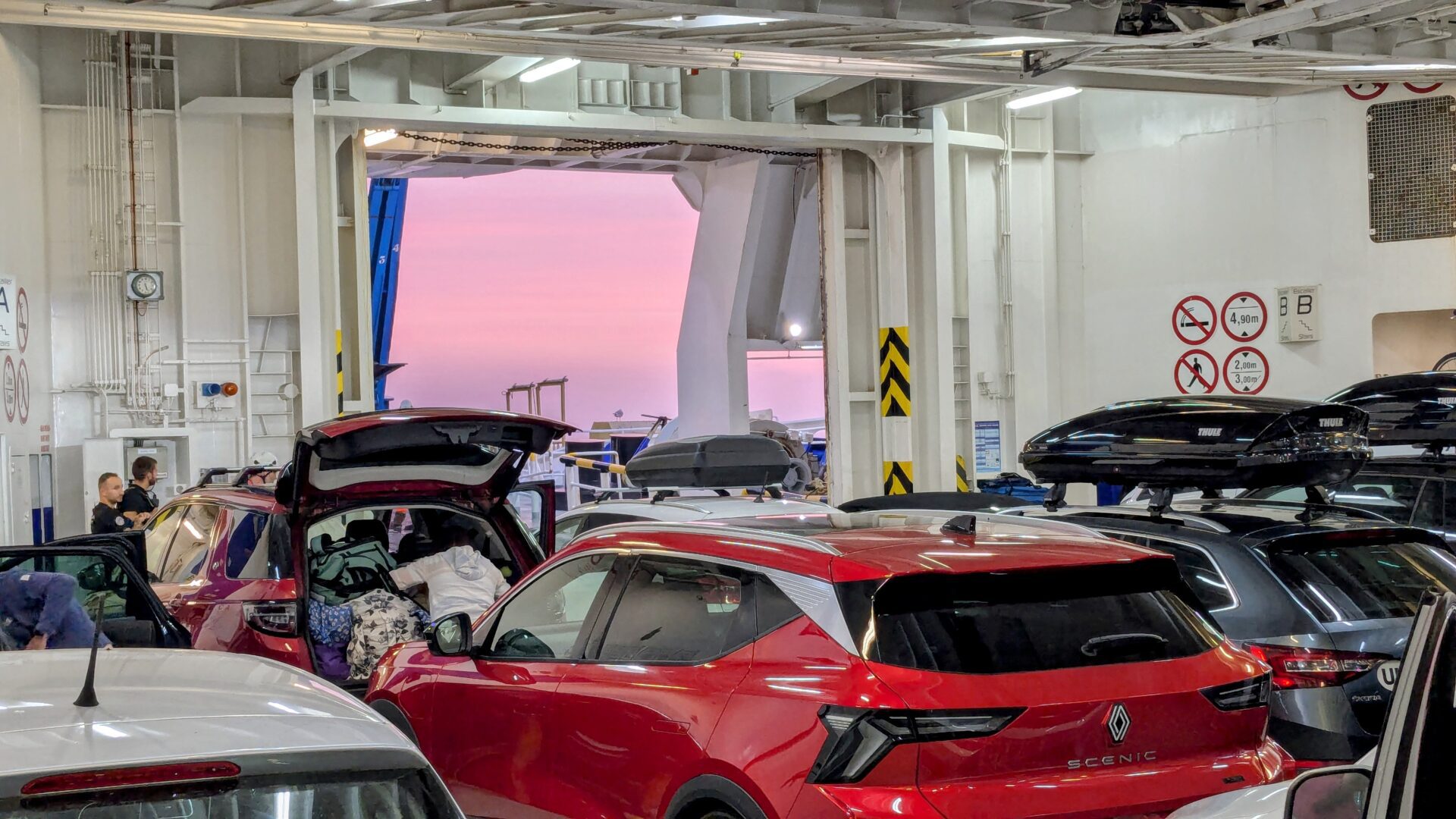
Travelling by ferry should be one of the more relaxed ways to start a holiday – and it genuinely is, once you know what you’re doing. But if it’s your first time, the range of requirements, rules and decisions to navigate before you even reach the port can feel a bit overwhelming.
Take my mum, for example, who rocked up to Portsmouth ferry port sans visa (as an Aussie native). Falling at the very first hurdle, we were only able to begin our French odyssey a few days (and a quick trip up to London’s embassy district) later!
This guide covers everything a first-time ferry traveller from the UK needs to know: the documents you’ll need, vehicles allowances and driving in Europe, cabins versus seats, travelling as a foot passenger, pets, accessibility, and what to actually expect on the day. By the end of it, you’ll be more than ready.
Ferry Travel Document Requirements
Do I Need a Passport to go on a Ferry?
Yes, of course you do! And there are no exceptions. Whether you’re crossing from Dover to Calais (90 minutes) or Portsmouth to Santander (24+ hours), you’re leaving one country and entering another. A valid passport is required for every passenger, regardless of age, and regardless of whether you’re travelling by car or as a foot passenger.
A few other things worth checking before you travel:
- Validity: some European countries require your passport to have at least three months of validity remaining beyond your planned departure date from the EU. Check this well in advance, ’cause passport renewal can take several weeks. Renewal application taking longer than expected is one of the most common reasons people miss their ferry.
- Non-UK nationals: if you’re not a British passport holder, check the visa requirements for every country you plan to visit. As my mum learned the hard way.
- Children: every child needs their own passport. A child listed on a parent’s older-style passport is no longer accepted at any UK-Europe border.
Here’s a link to the passport requirements for Irish Ferries, DFDS, and Brittany Ferries. The info doesn’t really change between companies either, as these requirements must align with the general rules for travelling to the EU.
The EU Entry/Exit System (EES): What Ferry Travellers Need to Know in 2026
This is the biggest change to UK-EU ferry travel since Brexit, and it’s one that first-timers in 2026 absolutely need to understand before they travel.
The EU Entry/Exit System launched in October 2025. It replaces the old passport stamp system with a digital border record for all non-EU travellers, which now includes British citizens following Brexit. Here’s what that means in practice…
What actually happens at the border under EES?
On your first entry into the Schengen Area after registration, you’ll need to provide biometric data at border control (typically a facial scan and/or fingerprints). This is done at the port, either before you board in the UK or on arrival at your destination, depending on which route you’re taking.
Ferry operators including Brittany Ferries, P&O Ferries, DFDS and Irish Ferries have confirmed that the location of this check varies by route, so if you really need to know before travel then check directly with them.
Do I need to register for EES in advance?
No. EES registration is completely free and requires no pre-travel applications. The registration simply takes place at the border during your first crossing. Once registered, your record is valid for up to three years, so future crossings only require a quick passport or biometric check rather than a full registration.
How much time does EES add to the process?
The registration itself takes only a few minutes per person. However, ferry operators are strongly advising travellers to allow more time at the port, particularly during peak periods, as queues are longer while the system continues to bed in.
As a practical rule: add at least 30 minutes to your port arrival time compared to what you might have planned before EES was introduced. Ferry companies will specify a minimum check-in time for your booking, so treat that as the absolute latest, not a target.
⚠️ EES and the 90-day rule: EES also enforces the Schengen 90-day rule more rigorously than before. British travellers can spend a maximum of 90 days in any 180-day period across the Schengen Area. EES tracks this digitally, so overstaying is now significantly easier for border authorities to detect. So…if you travel to Europe frequently, keep track of your days carefully, otherwise you might just get a bollocking and a fine from Miguel or Francoise at the border!
Full Document Checklist for Individual Travellers
- Valid passport: for all passengers, adults and children alike. Check expiry dates and ensure at least three months of validity beyond your planned return date from the EU.
- Visa (if required): British passport holders don’t need a visa for short stays (up to 90 days) in most EU countries. Non-UK nationals should check entry requirements for every country on their itinerary before booking anything.
- Ferry ticket/booking confirmation: have both a digital and printed copy. Some ports have poor signal, and a printed backup has saved many a stressed traveller at the check-in booth.
- Travel insurance documents: always travel with a copy of your policy, including the emergency contact number. Keep it accessible, not buried in an email folder. Heymondo offer great prices across Europe for both short and long-stays, as well as annual multi-trip policies.
- EHIC or GHIC card: your European Health Insurance Card or UK Global Health Insurance Card isn’t a substitute for travel insurance, but it does entitle you to access state healthcare in EU countries. Apply free via the NHS website if you don’t have one.
Car Ferries & Driving in Europe
What Vehicles are Allowed on Ferries?
Generally speaking, standard bookings typically cover cars up to around 5 metres long and 2 metres high, so everyday hatchbacks, saloons, and small SUVs are usually fine. Vehicle types allowed with each ferry company do however differ slightly, so here are direct links to Brittany Ferries, P&O, DFDS Seaways, and Irish Ferries on this particular topic.
Roof racks, bike carriers and oversized vehicles
If your vehicle has a roof rack, roof box, bike carrier, or anything attached to a tow bar, you must include those attachments when calculating your total vehicle dimensions. Many first-timers book a standard car fare and then arrive at the port with two bikes on the back and a roof box on top, which puts them in a different, more expensive vehicle category and can cause real problems at the boarding gate.
Vans, campervans, motorhomes and vehicles with trailers must be declared separately at the time of booking. These fall into different pricing categories and may require specific deck allocation on the ship.
The rule here is simple: measure everything, declare everything, and book accordingly. Being turned away or charged extra at the port because you under declared your vehicle is a miserable way to start a holiday. It’s the ferry equivalent of having your ‘carry on’ measured at the airport boarding gate and getting nailed with a fine.
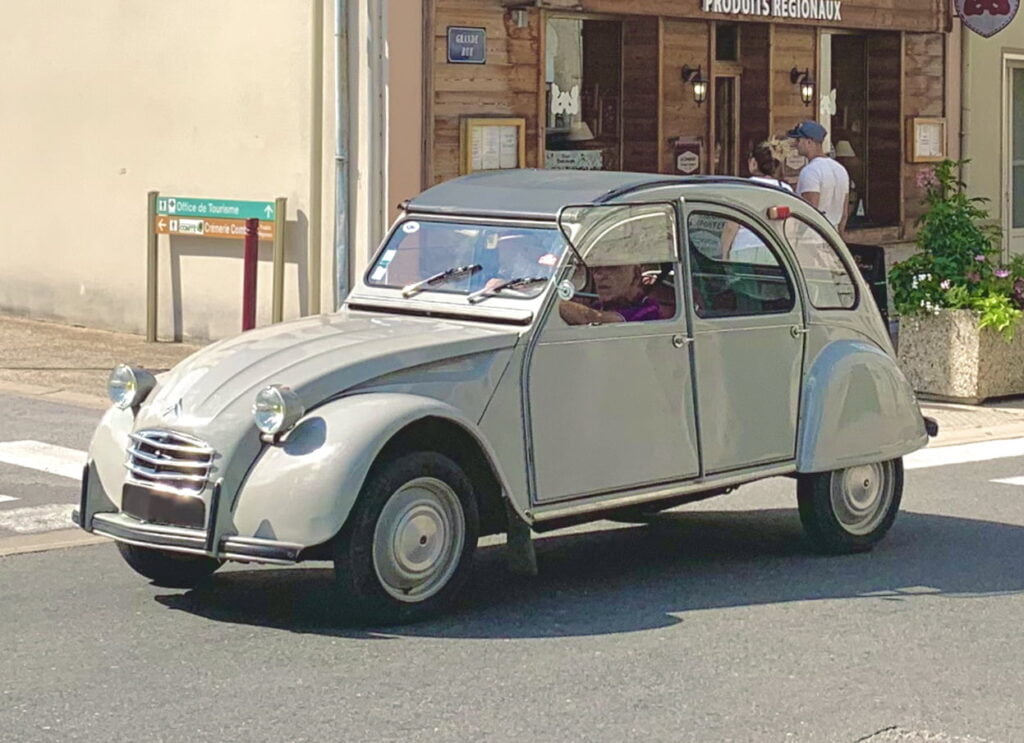
Do I Need a Car Sticker to Drive in Europe?
It depends on your number plate, but the rule is straightforward once you know it.
If your number plate already displays the UK identifier (i.e says ‘UK’ on it) alongside the Union Jack, you don’t need a separate sticker.
If it doesn’t, or if it shows anything other than UK + Union Jack, you do need one. Specifically, a white oval UK sticker on the rear of your vehicle is mandatory if your plate:
- Shows only numbers and letters, with no flag or identifier
- Displays a GB identifier (the old pre-Brexit version)
- Shows a European Union flag
- Features the national flag of England, Scotland or Wales
📌 Spain, Cyprus and Malta: regardless of what your number plate shows, you must always display a UK sticker when driving in these three countries.
📌 Republic of Ireland: no UK sticker required, regardless of your number plate.
📌 Old GB stickers must be removed or covered before driving outside the UK. They’re no longer valid and may result in a fine.
The simplest solution for most people is a European driving kit (see the next section), which includes a magnetic UK identifier along with all the other items you’ll need driving legally in Europe.
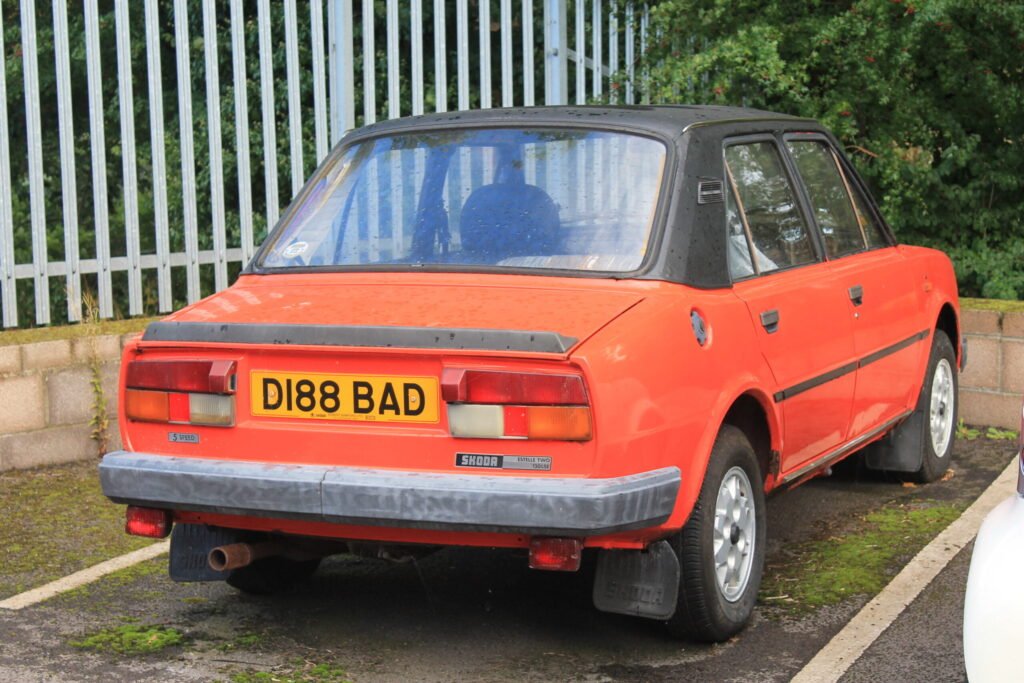
Vehicle Document Checklist
- Driving licence: always carry your valid UK photo card licence. UK licence holders do not need an International Driving Permit (IDP) to drive in EU countries, Switzerland, Norway, Iceland or Liechtenstein. If you hold a non-UK licence, check whether an IDP is required for the countries you’re visiting.
- Vehicle registration document (V5C): carry your logbook. It proves the vehicle is registered to you in the UK and, while unlikely, it could be requested at borders and by police in some European countries.
- Vehicle insurance certificate: confirm with your insurer that your policy covers driving in Europe and meets the minimum requirements of each country you plan to visit. Many UK policies now default to third-party cover only when abroad, so check your certificate carefully before assuming you’re fully covered.
- Breakdown cover documentation: ensure your breakdown cover extends to Europe and carry the policy documents and emergency number. If your current cover doesn’t extend abroad, add it before you travel.
- Environmental zone stickers where applicable: France’s Crit’Air scheme requires a windscreen sticker for driving in many urban low-emission zones. These must be ordered online in advance – you cannot buy them on arrival. Other countries have their own schemes, so check the requirements for each country on your route.
- Toll tags and vignettes where applicable: Austria, Switzerland and several other countries require the purchase of a road tax vignette for motorway use. Check requirements before you travel as driving without one can result in fines that dwarf the cost of the vignette itself.
A European Driving Kit: What's Legally Required?
The following items are either mandatory or strongly advised when driving in mainland Europe. In France, Spain, Germany, Italy, Belgium, Austria and Poland in fact, most of these are required by law, and you’ll be fined for not having them in your car.
- Reflective/hi-vis vests: required in many European countries. They must be accessible inside the car, not in the boot, so you can put one on before you exit the vehicle in an emergency or breakdown.
- Warning triangle: must be placed behind your stationary vehicle to warn approaching traffic in the event of a breakdown or accident.
- Headlamp beam deflectors: right-hand drive cars dip their headlights to the left, which means they dip into oncoming traffic when you’re driving on the right. Beam deflector stickers redirect the dip and are essential for any night driving in Europe.
- First aid kit: mandatory in some countries, strongly advisable everywhere.
- Breathalyser: legally required in France. Pre-sealed single-use ones are the standard.
The easiest approach is buying a pre-assembled European driving kit, which typically includes all of the above plus a UK sticker. They’re widely available online and far cheaper than an on-the-spot fine in Normandy. For anyone heading all the way over to central Europe, by the way, I’ve also written a guide on driving in Austria.
How Much Alcohol Can I Bring Back from Europe?
One of the biggest advantages of taking your car on a ferry is the ability to bring loads of ‘souvenirs’ back with you! It’s important though, to know the limits for bringing booze and other goodies back to the UK, as if you’re way over and you end up getting them confiscated, it’s gonna be one hell of a staff party at Portsmouth customs at your expense!
Here’s what you’re legally allowed to bring back into the UK:
| Type of Alcohol | Allowance |
|---|---|
| Beer | 42 litres |
| Still wine | 18 litres |
| Spirits (over 22% ABV) | 4 litres |
| Other alcoholic drinks up to 22% ABV (cider, port, sherry, sparkling wine) | 9 litres |
The beer and wine allowances are separate from the spirits/other allowance, so you can actually bring all of them back with you if you want. You can also split the spirits/other allowance, for example: 2 litres of spirits and 4.5 litres of sparkling wine. Full and up-to-date details are on the gov.uk website – defo worth a quick check before you load up.
Customs & Immigration: What to Expect on the Day
Customs and immigration used to be fairly routine for ferry travellers – a passport stamp, a cursory glance into your car from Jean-Jacques, and on you went. Since October 2025 and the introduction of EES, though, the process is slightly more involved, particularly for first-time crossers. Here’s what to expect at each stage…
At the UK port (departing)
Drive up to the check-in booths, and present your booking confirmation and passports. Depending on your route and operator, UK Border Force may also carry out passport and document checks here, and on some routes, EES biometric registration also happens at the UK port before departure.
After check-in, you’ll be directed to holding lanes on the car deck approach. These lanes can get busy during peak periods, so arrive at the port with plenty of time to spare. I used to love this part when I was a kid ’cause I could see all the other families and kids about to start their holidays too!
Most operators recommend arriving at the port at least 45 minutes before departure for car ferry crossings, but given EES queues in 2026, erring on the side of 60-90 minutes is certainly the wiser move.
On arrival at your destination port
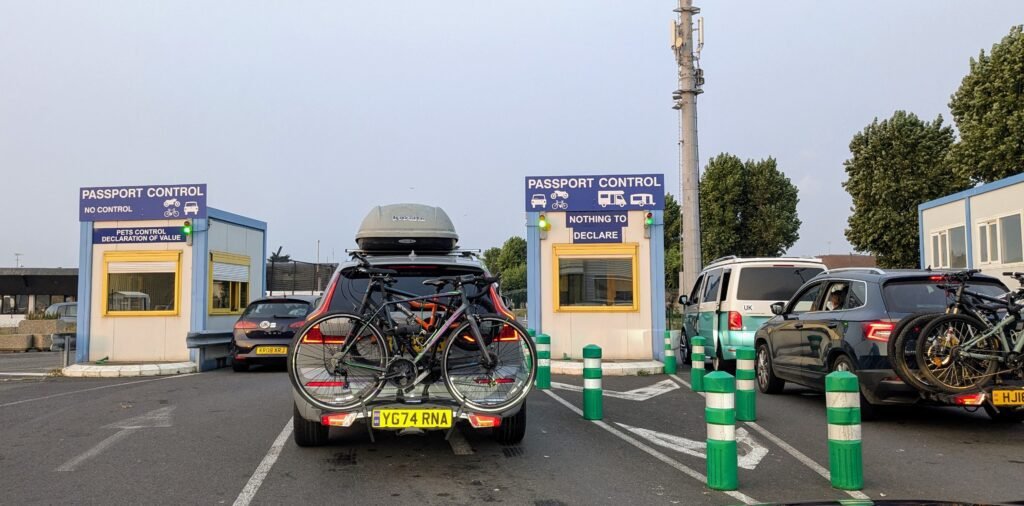
On arrival you have to go through immigration – either EU border control (if arriving in a Schengen country) or the relevant national border authority. This is where EES biometric checks will take place if they weren’t done at the UK port.
Customs checks on arrival aren’t carried out on every passenger, but you may be directed to a secondary inspection lane if you’re carrying anything likely to attract attention – so maybe hide the treasure chest and dead bodies 😉
Where and How to Book Ferry Tickets
Book Direct or Use a Comparison Site?
If you already know which route you’re taking and which operator runs it, booking directly with the ferry company is generally the better option. That’s because if something goes wrong, like a delayed departure, a need to rearrange, or a cancelled sailing, you’ll have a far easier time dealing with the operator directly than going back and forth with a third-party booking platform. It’s similar to how airline tickets work in this regard.
That said, if you’re not sure which route or operator offers the best deal for your dates, it’s absolutely worth checking Direct Ferries first, as they aggregate the widest range of routes and prices across all operators. My tip is to use them to compare, then book direct if the prices are similar. Having said that, Direct Ferries can offer better prices than going direct, so keep that in mind too.
And if you don’t know which route to take yet, definitely check out my detailed guides on ferries to France, Spain, ferries to and from Ireland, and England to Holland crossings. Each guide includes full details of all the routes available to you, which ferry companies operate them, as well as giving you direct booking links and all the best current deals.
Tips for Getting the Best Price
- Book early: ferry prices, like flights, tend to rise as the departure date approaches, especially in summer. Booking months ahead can save you loads of cash!
- Be flexible on timing: early morning or late-night departures are often cheaper than peak daytime crossings.
- Travel midweek if you can: weekend sailings, particularly Fridays and Sundays, carry a premium on most routes.
- Choose your vehicle category carefully: make sure you’ve selected the right vehicle category when booking. Being bumped up to a larger category at the port is almost always more expensive than getting it right first time at the time of booking.
- Check for loyalty schemes: Brittany Ferries’ Club Voyage programme, for example, offers discounts for regular travellers on both France and Spain crossings.
Cabins vs Seats: Which Should You Book?
Right, let’s talk whether or not to pay more for a cabin, or to rough it with the unwashed masses in the cheap(er) seats..
Day Crossings
You don’t really need a cabin for day crossings. There’s usually plenty to do on-board and you’ll be wanting to explore the ferry and spend time out on deck if the weather’s nice during the day.
Most day crossings are also short enough that a comfortable seat or lounge area is enough for most people. That said, if you’re travelling with young children or anyone who needs a quiet space during the crossing, a cabin might still be worth considering.
Overnight Crossings
As for overnight ferries, I’ve done both seat-only and private cabin crossings. And let me tell you, as I’m getting a little older, I definitely recommend booking yourself a cabin, despite how tempting it is to try and save a bit of money.
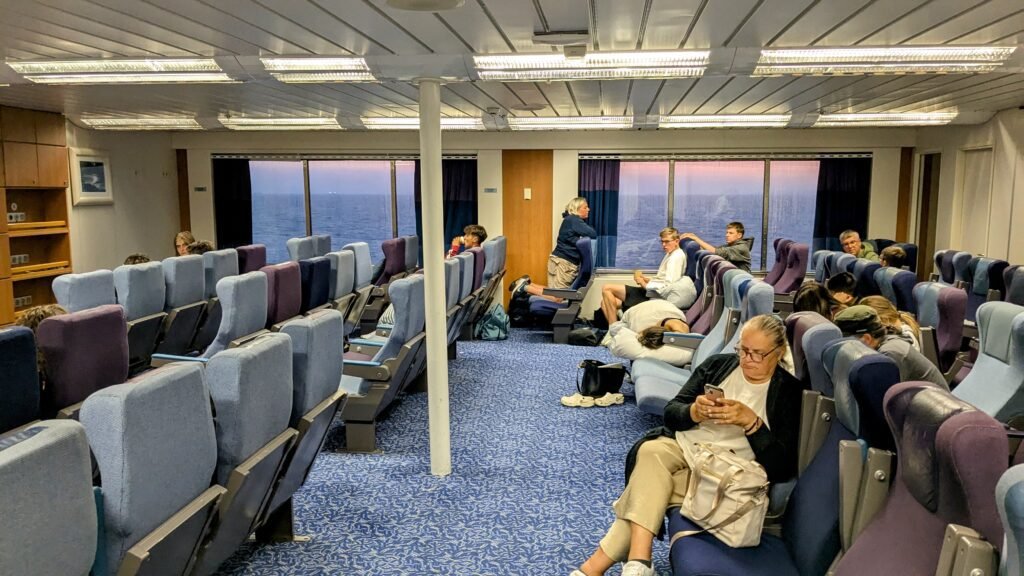
On a seat-only overnight fare, you’re in a shared reclining-seat lounge, sleeping across lumpy armrests (or trying to), with people coming and going, lights never fully off, and varying levels of snoring from your neighbours. I did this between Portsmouth and Caen overnight last year, and my first day in France was a bit of write-off as a result!
In a cabin, you get a proper bed, peace and quiet, your own bathroom and toilet (usually), and a super cosy experience. I personally find sleeping in ferry cabins to be really comforting due to the constant low hum of the ferry engines which lulls you off to sleep in no time.
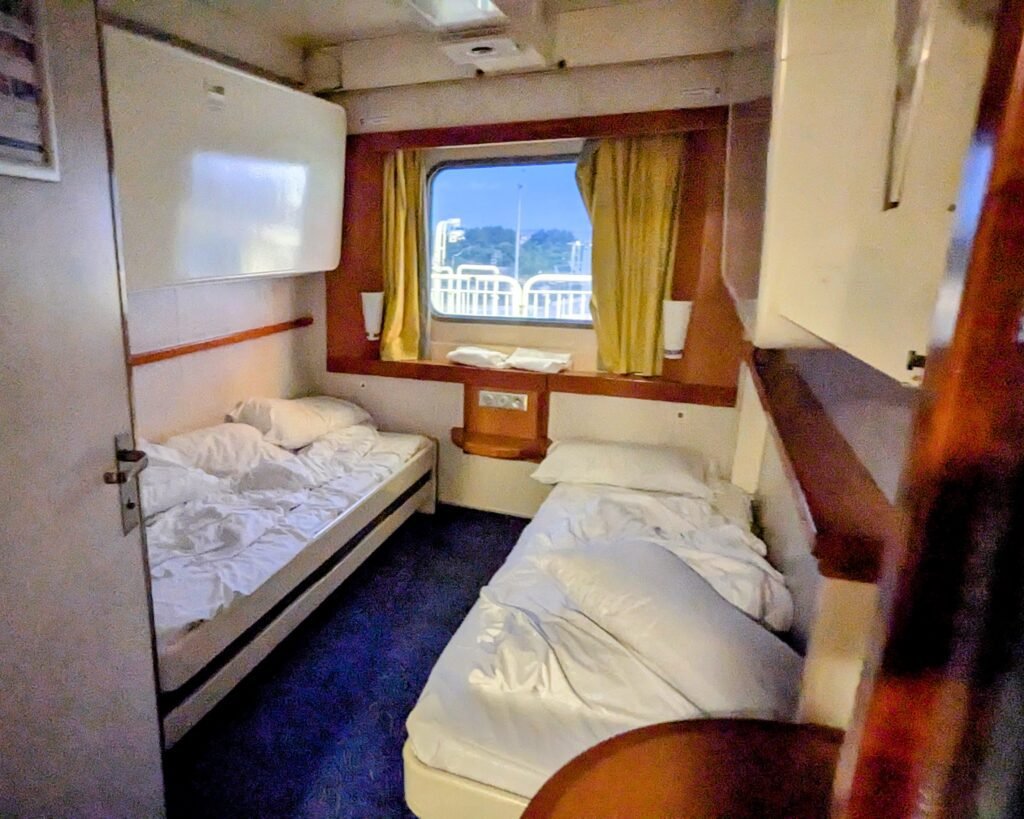
Bottom line – there’s no competition – if you’re travelling by ferry from the UK on an overnight crossing then ALWAYS pay the extra for a cabin with your own bed. Otherwise, unless you’re one of those super lucky people who can literally sleep anywhere, there’s a decent chance that your first day in France, Spain, Ireland or the Netherlands will be a hazy fog of stiff tiredness.
📌 Cabin booking tip: cabins sell out early on popular overnight routes, especially in peak season. Book yours at the same time as your ferry ticket and don’t assume you can just add it later, as there’s limited availability.
What Onboard Facilities Can I Expect?
One of the genuinely enjoyable parts of ferry travel is exploring the ship once you’ve boarded. This was one of the highlights of the entire journey for me. Facilities vary between operators and vessels, but on most major UK-Europe routes you can expect the following:
- Restaurants and cafés: from full à la carte dining to cafeteria-style hot food and decent coffee bars. Quality has improved significantly across the major operators in recent years.
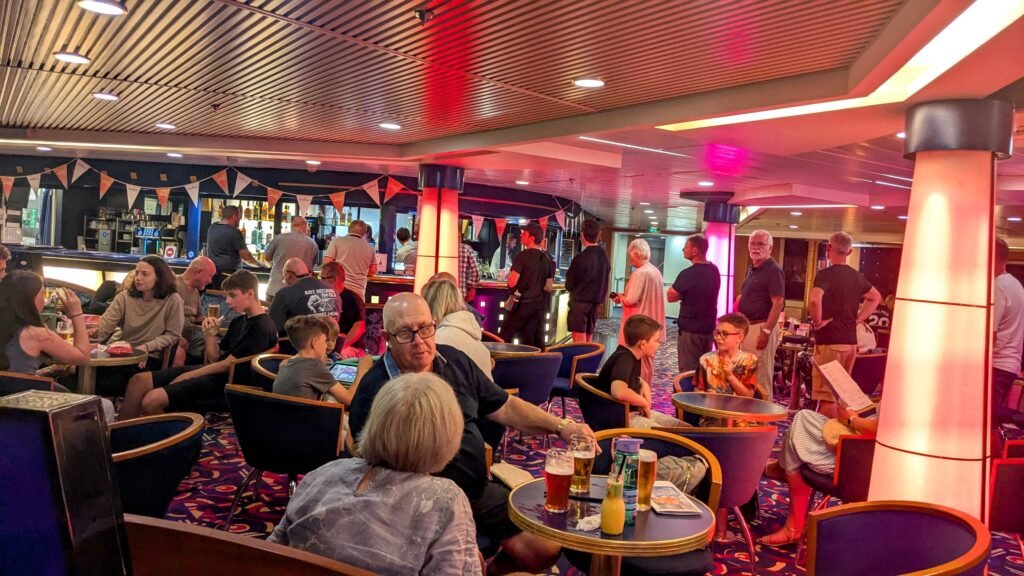
- Bars: the social heart of any good ferry, especially on evening and overnight crossings.
- Duty-free shops: alcohol, perfume, chocolate (why is it always M&Ms though?!). Prices on spirits in particular are legit.
- Outside decks: the best free entertainment on any ferry. Watching the UK coastline disappear, or France appear on the horizon, is one of those simple travel pleasures that never gets old.
- Children’s entertainment: on longer routes, particularly Brittany Ferries crossings to Spain, there may be dedicated kids’ clubs, cinemas and activity programmes.
- Swimming pools: a handful of the larger Brittany Ferries ships have outdoor or indoor pools on selected routes. Worth checking if this matters to you when choosing your vessel.
I love exploring the ship straight after boarding, but best of all for me, is getting out on deck and watching as you slowly chug away from the port! The wind is invigorating, the struggle to open the door to get out on deck challenging, and the views of the wide open ocean life liberating.
What to Pack for the Crossing?
This is specifically about what to bring with you for the journey itself, NOT your holiday packing. Here are the things people often wish they had on board, but didn’t…
- Sea sickness tablets or acupressure bands: even on relatively calm crossings, the motion of a ship can catch people off guard, particularly in the English Channel in autumn or winter. Take medication before you board, not once you’re already feeling rough, as it’s usually less effective then. Acupressure wristbands might work for some keen to avoid medicines and tablets.
- Snacks and drinks for the vehicle lane wait: you’ll typically spend 20-45 minutes in the holding lanes before boarding. Have snacks and drinks to hand, especially if you’re travelling with kids.
- Entertainment and headphones: for longer crossings, download content to a tablet or phone before you leave. Ship Wi-Fi varies wildly in quality, so don’t rely on it for streaming.
- A dedicated bag for the crossing: you can’t return to your vehicle once the ferry is at sea, so pack a bag with everything you’ll need: documents, medications, phone charger, entertainment, and anything else for the kids.
- Something warm for the outside deck: even in summer (and especially at night), standing on an open deck at sea can get cold. A jacket or jumper makes a huge difference to how long you’ll actually enjoy being out there!
- Earplugs and an eye mask: useful for all overnight crossings, especially if you decide to go for the cheap seats. The engine hum is comforting; but even if you have booked a cabin, the corridor noise from other passengers at 2am is somewhat less so.
Travelling as a Foot Passenger
Travelling as a foot passenger is a perfectly viable option on many routes but it’s more restrictive than taking a car, and the rules vary considerably between operators and routes…
What You Need to Know Before Booking
Most importantly, not all routes accept foot passengers! And those that do often have limited availability. The Dover to Calais corridor – the UK’s busiest crossing – is the most restricted:
- P&O Ferries only accept foot passengers on a limited number of daily Dover-Calais sailings. Check availability carefully before booking.
- DFDS does not currently accept foot passengers on their Dover-Dunkirk or Dover-Calais routes at all.
Outside of the Dover Strait, options are considerably better. Brittany Ferries is the most foot-passenger-friendly of the major operators, with a range of routes from Portsmouth, Poole and Plymouth to France and Spain.
Check-in times, boarding procedures and disembarkation for foot passengers differ from those for vehicle passengers, and missing your boarding window can mean missing the sailing entirely, so definitely check out the link above to be in the know.
Rail & Sail: The Best Foot Passenger Deal Going
If you’re travelling without a car, Stena Line’s Rail & Sail deals are excellent value and worth serious consideration. The Dutchflyer Rail & Sail Rail, and Rail & Sail to Ireland include massively discounted rail and ferry combined fares from several different British cities, going all the way to their ferry ports in Ireland and the Netherlands.
Should You Travel as a Foot Passenger and Then Hire a Car on Arrival?
This is a genuinely good option in certain circumstances. Here’s when it most makes sense:
- When the cost saving on your ferry ticket outweighs the car hire cost in France, Spain or the Netherlands for the duration of your trip.
- When your UK car insurance or breakdown cover doesn’t extend to Europe, and the cost of upgrading it isn’t worth it for a short trip.
- If you’re nervous about driving on the right in a right-hand-drive car. Renting a left-hand-drive car locally removes this problem entirely, thus making overtaking considerably less stressful and dangerous.
If any of that makes sense to you then check out Discover Cars, as they aggregate the best prices of local vehicles from French, Dutch and Spanish car hire companies. I use them every time I hire a car in Europe and their prices are unbeatable.
Travelling With Pets on Ferries
If you’re planning on travelling with your furry friend, then steel yourselves as this is a pretty complicated topic which requires a lot of preparation on your part. If you’re travelling with a dog, cat or a ferret (who has a ferret?!), the requirements for travel between the UK and EU are:
- Animal Health Certificate (AHC) or EU Pet Passport: the AHC must be issued by an official vet no more than 10 days before travel. If your pet has an EU Pet Passport issued before Jan 1st 2021, check with your vet whether it remains valid.
- Rabies vaccination: your pet must be vaccinated against rabies, and for a first vaccination, this must have been administered at least 21 days before travel.
- Microchip: your pet must be microchipped, and the chip must have been implanted before or at the same time as their rabies vaccination.
- Tapeworm treatment for dogs returning to the UK: dogs must be treated for tapeworm by a vet between 24 hours and 5 days before arriving back in the UK. Get the timing right though, as this is a common trip-ender for people who leave it too late or miscalculate the window.
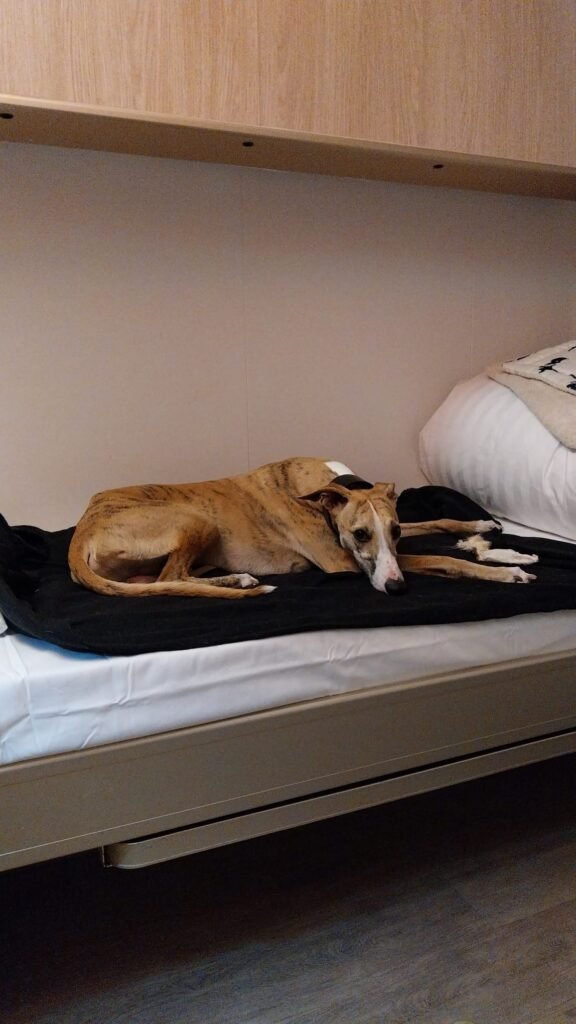
Furthermore, if your pet is a Tortoise (hurray!) or something equally exotic, you may also require a CITES certificate for entry into the EU – consult your vet well in advance and check the APHA (Animal and Plant Health Agency) guidance carefully.
Due to the complexity involved with bringing animals across borders, definitely review each carrier’s specific pet travel requirements and policies, as well as those for the country you plan to visit.
Here are the detailed pages on ferry pet travel for Brittany Ferries, P&O, DFDS, Irish Ferries and StenaLine. You’ll find details of their policies on where your animal can and can’t be on the ferry, potential kennel space on-board, as well as guidelines for boarding and other tips to make the journey for your pet as comfortable as possible. Speaking of which…
Where Does Your Pet Stay on the Ferry?
This varies between operators:
- Some operators require pets to remain in the vehicle on the car deck for the entire crossing.
- Others offer dedicated kennels or pet-friendly cabins. Brittany Ferries is particularly good for this on longer routes, with on-board kennels and selected cabins that accommodate pets.
- P&O Ferries also have a dedicated Pet Lounge on the Dover–Calais route. A pet lounge! I can only assume that this is where all those photos of dogs playing playing snooker and smoking cigars from the 80’s and 90’s came from!
Accessibility on UK Ferry Routes
All major UK ferry operators are required to provide accessible facilities, but the quality and detail of information available varies between companies. Here’s a summary of what each offers and how to find out more…
P&O Ferries offer some of the most comprehensive accessibility information of any UK operator. Their two newest ships on the Dover–Calais route; the P&O Pioneer and P&O Liberté, both have accredited Changing Places facilities, which are larger accessible toilets designed to support adults and children with complex disabilities. P&O also link to Euan’s Guide, an independent review platform where travellers with mobility issues share real-world experiences of specific ships and ports. Their full accessibility information is well-organised on a single dedicated page.
Brittany Ferries also has its own dedicated page with general travel advice for disabled passengers, from which they link to various other pages. The information is somewhat scattered across their site rather than consolidated in one place, which can make it harder to find what you need, but the information itself is reasonably thorough, and varies by ship and route.
Irish Ferries also have a very comprehensive special assistance page, where they detail wheelchair facilities across all their ships, their participation in the Sunflower Lanyard scheme for passengers with hidden disabilities, as well as various disability discounts. They ask passengers to contact their disability officer by email at least 48 hours before travel.
DFDS also participate in the Hidden Disabilities Sunflower programme and provide information on disabled toilet locations, lift dimensions and port facilities. If you require an accompanying person to travel with you, DFDS may also offer a free fare for that individual – so definitely worth asking about directly. They ask passengers with specific requirements to get in touch at least 48 hours before travel, ideally at the time of booking.
As a general rule: contact your ferry operator as early as possible (ideally when you book) if you have any specific accessibility requirements. All major operators are legally required to accommodate passengers with reduced mobility, and most have dedicated teams who handle these requests regularly.
What Actually Happens on the Day: A Step-by-Step Walkthrough
This is the section that most first-timer guides forget to include. Knowing what the document requirements are is one thing; knowing what the experience actually feels like from arrival at the port to driving off the other end is quite another. Here’s the typical flow for a car ferry crossing…
Step 1: Arrive at the port
Follow signs for your specific ferry operator. Ports serve multiple operators, so make sure you’re in the right check-in area. Prepare your booking confirmation and passports ready for the check-in booths. If you’ve printed a backup copy of your booking confirmation, now is when you’ll be glad you did.
Step 2: Check-in
Present your booking confirmation and passports at the booth. The agent will scan your booking and either issue boarding cards or apply a windscreen sticker to your car. If your vehicle with attachments is larger than what you booked, flag it here rather than at the boarding ramp, as it’s much easier to resolve at check-in.
Step 3: Border control/EES
Depending on your route, UK Border Force and/or EU border authorities may carry out passport checks and EES biometric registration at this stage. You’ll be directed through accordingly. Have passports ready for everyone in the vehicle, and allow extra time for this.
Step 4: Wait in the vehicle lanes
After check-in, you’ll be directed to numbered holding lanes. This is the part of ferry travel nobody warns you about: you may be here for anywhere from 20 minutes to over an hour, depending on the route and how busy it is. Have snacks, drinks and entertainment for the kids. You’re not going anywhere until the ferry is ready to load.
Step 5: Board the ferry
Loading is done by lane, in order. When your lane is called, you’ll drive forward and be directed onto the vehicle deck by crew with luminous wands. Do exactly what they say – the car decks are tight spaces, the crew do this all day, and the person waving you into a gap that looks far too small has done it approximately ten thousand times before. Park up, apply the handbrake, and take everything you’ll need for the crossing: documents, medications, valuables, anything for the children, and something warm for the deck. You can’t go back to your car once the ferry starts moving and is at sea.
Step 6: Enjoy the crossing
Head upstairs and explore. Get a coffee or a beer, and/or find a spot up on deck for departure to watch the port slowly disappear behind you. This is one of the best things about ferry travel! If it’s an overnight crossing and you’ve booked a cabin, find it early, dump your bags, and enjoy the smugness that accompanies having made such a excellent decision!
Step 7: Arrival and disembarkation
You’ll be called back to the vehicle deck shortly before arrival – just follow the PA announcements and signs. Vehicles disembark by deck level and lane, so just wait for the crew’s signal for your deck and then drive off. Immigration checks, including any remaining EES processes, may happen at this point if they weren’t completed at the departure port. And then you’re in France, Spain, Ireland, or wherever else! First crossing- done. Nailed it!
Frequently Asked Questions
Do I go through customs before I board or on arrival?
It depends on your route. For most UK-to-France crossings, you’ll go through UK Border Force before boarding and French customs on arrival. For some longer Brittany Ferries routes, the process may differ slightly. Check with your operator, and have your documents accessible at both ends.
Can I bring food on a ferry from the UK to France?
You can take most foods onto the ferry itself for the crossing. However, be aware of what you can and can’t bring into the EU – restrictions apply to meat and dairy products in particular. Worth checking the gov.uk guidance before you pack a cool box full of charcuterie.
What if I feel seasick?
The English Channel and Bay of Biscay can be rough, particularly in autumn and winter. If you’re prone to motion sickness, take medication before you board (not once you’re already feeling rough), stay on deck in fresh air where possible, focus on the horizon, and avoid enclosed spaces below deck. The mid-ship areas tend to move less than the bow or stern.
Can I stay in my car during the crossing?
No. For safety reasons, vehicle decks are closed to passengers once the ferry is at sea. You have to leave your vehicle before departure and cannot return until disembarkation. Plan accordingly and take everything you need with you.
Is it worth arriving early at the port?
Always. Check-in closes typically 30–45 minutes before departure for car ferry passengers, but arriving at that point leaves no buffer for queues, EES checks or last-minute complications. Aim to arrive at least 60–90 minutes before your scheduled departure, and maybe allow more during peak summer periods.
What happens if my ferry is cancelled or delayed?
If your sailing is cancelled by the operator, you’re entitled to a full refund or an alternative sailing. For significant delays, the operator should provide updates and may offer refreshment vouchers on board. Travel insurance that covers delays and cancellations provides additional protection, so have a read of your policy before you travel.
Can I take my bike on a ferry?
Yep, on most routes, but declare it at the time of booking. Bicycles typically fall under a separate booking category and are loaded separately from cars. The process is usually straightforward, just don’t leave it to add later.
UK Ferry Travel: Final Thoughts
I know all of this sounds like a lot, and reading it in one go does make ferry travel seem more daunting than it actually is. But in reality, once you’ve done it once, you’ll wonder why you ever put up with the dull monotony of airports!
The thing about ferries is that the journey itself becomes a big part of the experience. You’re on a ship, crossing the sea, with a bar, a deck, and the rather cinematic sight of a coastline slowly fading away into the distance behind you. For families especially, it’s a genuinely exciting way to travel, and one that children will remember long after they’ve forgotten every Ryanair departure lounge.
Get your documents sorted, declare your vehicle properly, allow extra time for EES, pack a bag for the crossing, and take a layer for the deck. Everything else takes care of itself.
If you’re looking for guidance on which route to take, my guides on ferries to France, ferries to Spain, ferries to Ireland and England to Holland ferries cover all available crossings, operators and pricing in detail. My entire back catalogue of ferry posts can be found here too.
I wish you a wonderful trip, and hope that you and your families create some lifelong memories too 🙂
Happy sailing!



Travelling afternoon from Portsmouth, arriving Caen late evening. My husband has food allergies and we will be packing a picnic supper. Do we clear customs before boarding the ferry, or on arrival in France?
Similar question for the return trip a week later (July) when we leave France 8.30 a.m.
Hi Jacky,
Thanks for your question! You’ll be going through customs on arrival in Caen, and it’s the other way around on your return to trip to Portsmouth, but be sure to have all your documents (including for passport control) within easy reach at both ports in each direction.
Not sure if baguettes, brie and wine are on your husbands banned list of foods, I certainly hope not for his sake!
Have a great trip – James