
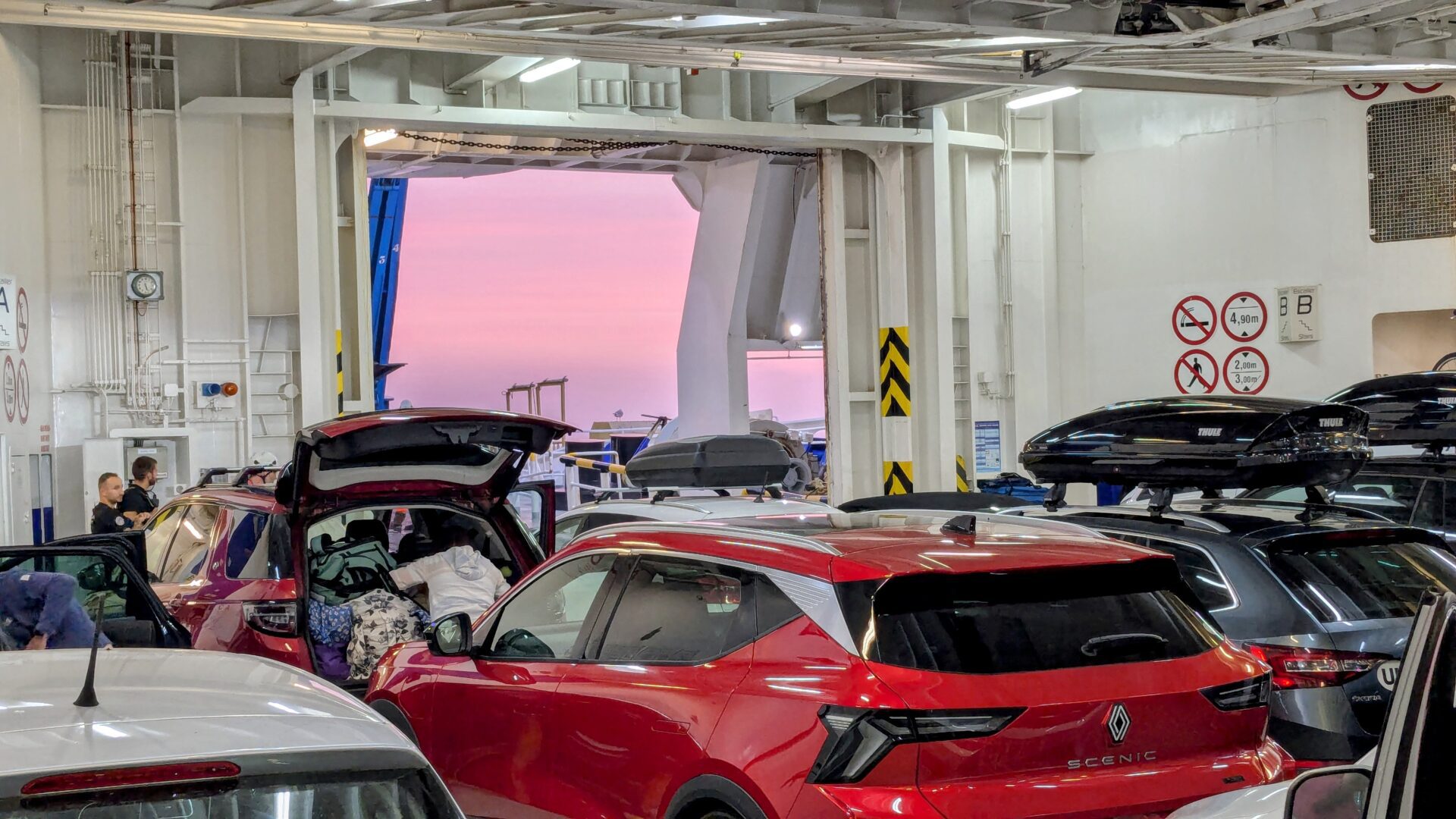
Travelling by ferry should be a relaxing and fun way to start your holiday, right? Well, if you’re organised then yes, it is, but if you’ve never done it before and aren’t aware of the many and varied ferry travel requirements, then it might not be smooth sailing!
Take my mum, for example, who rocked up to Portsmouth ferry port sans visa (as an Aussie native). Falling at the very first hurdle, we were only able to begin our French odyssey a few days (and a quick trip up to London’s embassy district) later!
This post is all about helping you navigate the most common ferry rules and requirements way before you arrive at the port, from document and vehicle requirements, travelling as a foot passenger, pets on ferries, accessibility, and driving in Europe.
A BEGINNERS GUIDE TO UK FERRY TRAVEL
FERRY TRAVEL DOCUMENT REQUIREMENTS
Do I Need a Passport to go on a Ferry?
Let’s start with the basics here. Yes, you do need a passport to go on a ferry to France, Spain, Ireland or any other country! And if that was genuinely a serious question then I’m also a little worried about you. As you’ll be leaving one country and entering another you need a valid passport for international travel – this is no different from if you were flying.
Here’s a link to the passport requirements for Irish Ferries, DFDS, and Brittany Ferries. The info doesn’t change between ferry companies, as these passport requirements must align with the general rules for travelling to the EU.
Also, check the expiration date on your passport to make sure it remains valid throughout your trip – it’s a good idea, in fact, to make sure it has at least 3 months of validity left, as some European nations require this. Depending on which passport you carry, some countries may also require a visa (as we learnt the hard way), so double check the entry requirements for countries you plan to visit.
The New EU Entry/Exit System (EES)
However, the recent introduction of the EU Entry/Exit System (EES) changes (slightly) how passengers travel by ferry between the UK and mainland Europe. Since October 2025, the system has replaced traditional passport stamping with a digital record for non-EU travellers, including UK citizens.
On your first entry into the Schengen Area, passengers need to register their passport and provide biometric data (typically fingerprints and a facial photo) at border control in the port. Ferry operators including Brittany Ferries, P&O Ferries, DFDS and Irish Ferries say that these checks may take place either before departure or on arrival depending on which route you take.
Importantly, the EES registration is completely free and there is nothing travellers need to apply for in advance; the process simply takes place at the border during the first trip. Once registered, the record is normally valid for up to three years, so future crossings only require a quick passport or biometric check.
While the registration itself only takes a few minutes, ferry companies recommend allowing extra time at the port, especially during the early rollout, as queues may be longer while the new system beds in.
List of ID Requirements for Individuals
- Passport: as already stated above, bring a valid passport for international travel for all passengers, regardless of whether you are traveling as a foot passenger or by car.
- Driving license: if you wanna drive in Europe then you’re gonna need this too.
- International driving permit: if you’re not British or European you may also need an International Driving Permit (IDP), which provides a translation of your national driving license into the language of the country you’re visiting. According to the .gov website though, UK nationals DO NOT need an IDP to drive in the EU, Switzerland, Norway, Iceland or Liechtenstein, assuming they have a photocard driving license issued in the UK. For those who need more info on this, I’ve written an entire article on what countries require an IDP.
- Ticket or booking confirmation: you’ll need your ferry ticket or booking confirmation to board. Best to have both printed and electronic versions as back up.
- Travel insurance: an electronic or paper copy of your travel insurance makes sense. For peace of mind, Heymondo offer great prices across Europe for both short and long-stays, and annual multi-trip insurance policies.
As always, the rules for travelling by ferry may change over time, so it’s probably worth checking again just before your departure, especially if you booked your ferry tickets a while back.
CARS ON FERRIES & DRIVING IN EUROPE
What Vehicles are Allowed on Ferries?
The types of vehicles allowed on each ferry company differs slightly, so here are direct links to Brittany Ferries, P&O, DFDS Seaways, and Irish Ferries on this particular topic. Generally speaking though, standard bookings typically cover cars up to around 5 metres long and 2 metres high, so everyday hatchbacks, saloons, and small SUVs are usually fine.
Bigger Vehicles & Roof Racks
If you plan to board a ferry with a roof rack, or in a vehicle with measurements larger than the standard dimensions mentioned above, then be sure to include anything attached to your vehicle like roof boxes, bike racks etc. when calculating your total size.
If you’re travelling with a van, campervan, motorhome, or anything with a trailer, you’ll also need to declare that when you book, as these larger vehicles typically fall into different categories and may cost more…
When calculating your vehicle size, be sure to do the following:
- Check the links above to see your ferry operator’s size limits for standard and oversized vehicles.
- Then measure (or look up) your vehicle’s total length, height, and width. Don’t forget to include roof racks, bike carriers, trailers etc., and declare it all when booking!
- Be sure to choose the correct vehicle category when booking to avoid extra charges or being turned away at the port.
- Arrive early – oversized vehicles often need extra time for boarding.
Do I Need a Car Sticker to Drive in Europe?
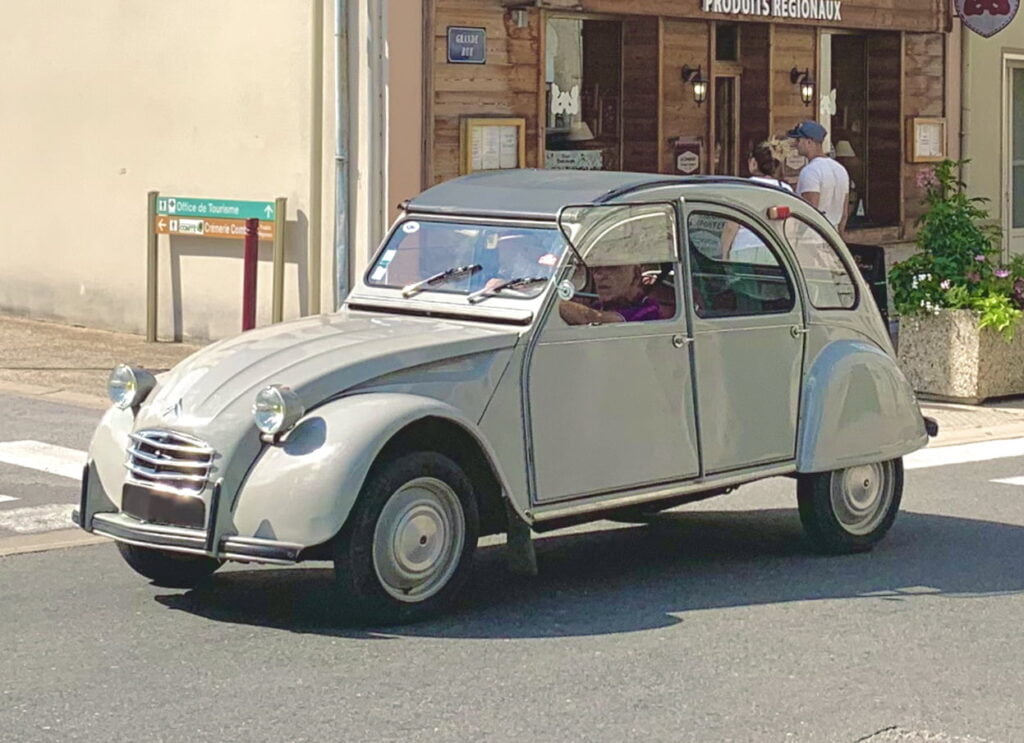
When driving outside the UK, it may be necessary to affix a white oval UK sticker to the rear of your vehicle. This requirement depends on the configuration of your number plate and your intended destination. Basically, if your number plate already features the UK identifier accompanied by the Union Jack you don’t need a separate UK sticker.
However, a UK sticker is mandatory if your number plate falls into any of the following categories:
- Comprises solely numbers and letters, devoid of any flags or identifiers.
- Displays a GB identifier alongside the Union flag.
- Incorporates a European Union flag.
- Features a national flag of England, Scotland, or Wales.
Note that UK stickers have superseded the previous white oval GB stickers, so if you currently have a GB sticker, it must either be covered or removed before driving outside of the UK. Don’t attach the sticker directly onto your number plate. You can get a UK identifier as part of a comprehensive European safety driving kit, which also includes other essential items including, Hi-Vis vests, headlight deflectors, foil blanket, a first aid kit, and warning triangle. More these legal requirements for driving in Europe below…
Driving in Spain, Cyprus, and Malta: To drive in Spain, Cyprus, or Malta, you must ALWAYS display a UK sticker, regardless of the content of your number plate.
Driving in the Republic of Ireland: When driving in the Republic of Ireland, there is no need for a UK sticker, regardless of the content of your number plate.
List of Vehicle Document Requirements
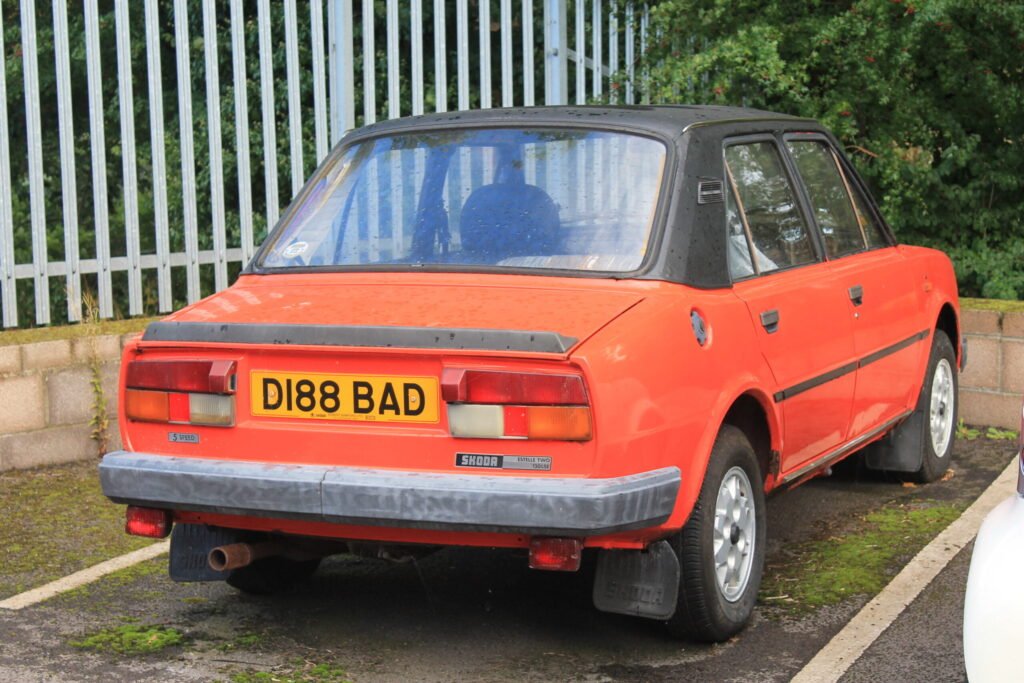
- National driver’s license + (in some cases) an International driving permit: as mentioned above, you must always bring with you a valid driver’s license from your home country. Additionally, depending on where you’re from, what language your home license is issued in, and where you’ll be driving, you may also need an International Driving Permit (IDP).
- Vehicle registration: Carry your vehicle’s registration documents, which prove ownership and registration in your home country.
- Insurance and breakdown cover: Ensure you have valid vehicle insurance coverage for the countries you intend to visit. Contact your insurance provider to confirm that your policy covers driving in Europe and meets the minimum requirements of the countries you plan to visit. Ensure that your policy includes international breakdown/accident cover and have this with you at all times in case anything does happen.
- Environmental stickers: In some European cities, particularly in the increasing number of low emission/environmental zones, you may need an environmental sticker (e.g., Crit’Air in France) to enter certain areas. These stickers are usually only required for older, more polluting vehicles though.
- Toll tags and vignettes: Some European countries require payment of tolls or the purchase of vignettes (road tax stickers) for certain highways or roads. Check the specific requirements for the countries and cities you plan to visit.
European Driving Kit
- Reflective vests: In many European countries, it is a legal requirement to carry high-visibility reflective vests or jackets in the car. These should be easily accessible and used when you exit the vehicle in case of an emergency or breakdown.
- Warning triangle: A warning triangle is required in many European countries. It should be placed behind your vehicle to warn other drivers in case of a breakdown or accident.
- First aid kit: While not mandatory everywhere, it is advisable to carry a first aid kit in your vehicle.
- Headlamp beam deflectors: If your car has right-hand drive and you’re driving in a country that drives on the right side of the road, you may need headlamp beam deflectors to avoid blinding oncoming drivers.
How Much Booze Can I Bring Back From Europe?
Of course, one of the biggest benefits of taking your car on a ferry is the ability to bring back with you loads of ‘souvenirs’! It’s important though, to know the limits for bringing booze and other goodies back to the UK, as if you’re way over and you end up getting them confiscated, it’s gonna be one hell of a staff party at Portsmouth customs at your expense!
Full details for bringing alcohol into the UK can be found here on the official UK govt website, but in summary, alcohol allowance depends on the type of booze you’re bringing back:
beer = 42 litres AND/OR wine (not sparkling) = 18 litres
It gets a bit more complicated when you move away from beer and wine, in that you can ALSO bring in either:
spirits (over 22% a.b.v) = 4 litres OR ‘other alcoholic drinks’ (up to 22%) = 9 litres
‘Other alcoholic drinks‘ in this case usually refers to cider, port, sherry and sparkling wines. According to the gov.uk website: “You can split this last allowance. For example, you could bring 2 litres of spirits and 4.5 litres of fortified wine.” It might just be easier to stick with the San Miguels and 1664’s then.
CUSTOMS AND IMMIGRATION PROCEDURES
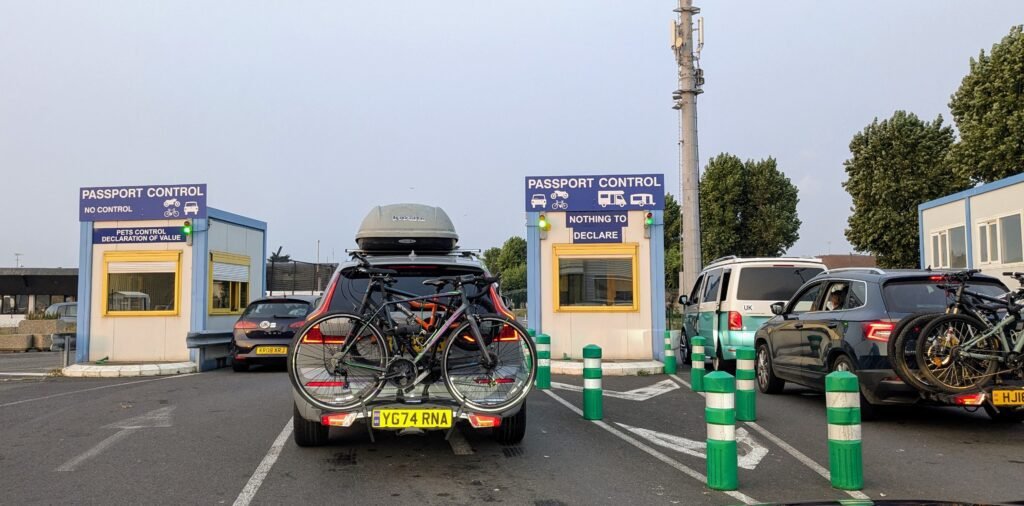
Be prepared to go through customs and immigration procedures either on arrival at your destination or prior to your departure at your home port, or both. There may be a bit of queue at each end (more so now since the gradual introduction of the EES), but these are generally well-oiled machines and you’ll soon be on the road and ready to explore.
WHERE TO BOOK CHEAP FERRY TICKETS?
You may already have a clear idea of where to book your ferry tickets online, but if not then my guides on ferries to France, Spain, ferries to and from Ireland, and UK to Netherlands ferries include full details of all the routes available to you and which ferry companies operate them.
Once you know which company operates your route, I recommend buying your ferry tickets directly from them. I say this because if things go tits up, and you need to rearrange your plans, the customer service you’ll get when dealing directly with the ferry company will probably be better than if your ticket was purchased via a third party aggregator. It’s similar to how airline tickets work in that regard.
Having said that though, it’s also worth checking with Direct Ferries, as they collate the largest range of possible routes and current deals offered by each company, sometimes even offering cheaper ferry tickets.
IS IT WORTH BOOKING A CABIN ON A FERRY?
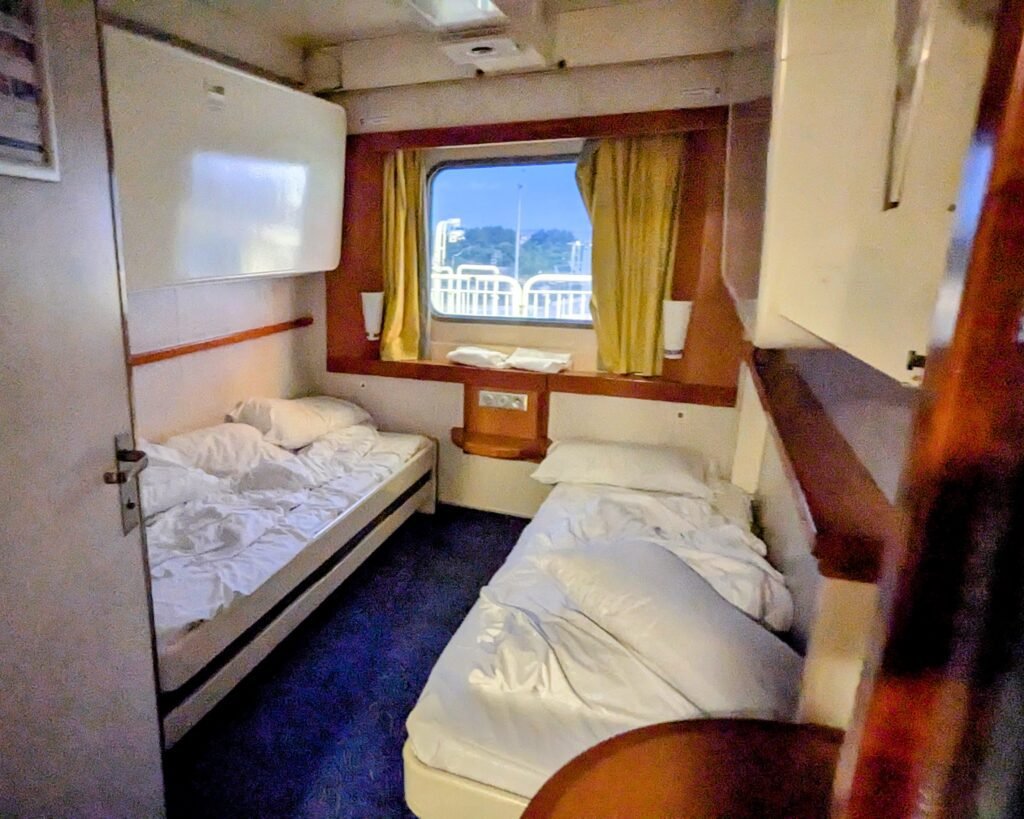
Right, let’s talk whether or not to pay more for a cabin, or to rough it with the unwashed masses in the cheap(er) seats. Firstly, you don’t really need a cabin for day crossings. There’s usually plenty to do on-board and you’ll be wanting to explore the ferry and spend time out on deck if the weather’s nice during the day.
As for overnight ferries, I’ve done both seat-only and private cabin crossings. And let me tell you, as I’m getting a little older, I definitely recommend booking yourself a cabin, despite how tempting it is to save money.

In a cabin, you’ll get bed rather than just a seat, and you won’t be kept awake by lying across multiple arm rests, having to sleep on the floor, people coming in and out of the room, snoring, and from generally being uncomfortable.
Besides, I find sleeping in ferry cabins to be really comforting and cosy, perhaps due to the constant low hum of the ferry engines. Either way, there’s no real competition here – if you’re travelling by ferry from the UK on an overnight crossing then ALWAYS pay the extra for a cabin with your own bed. Otherwise, there’s a decent chance that your first day in France, Spain, Ireland or the Netherlands will be a hazy fog of tiredness!
Onboard Facilities
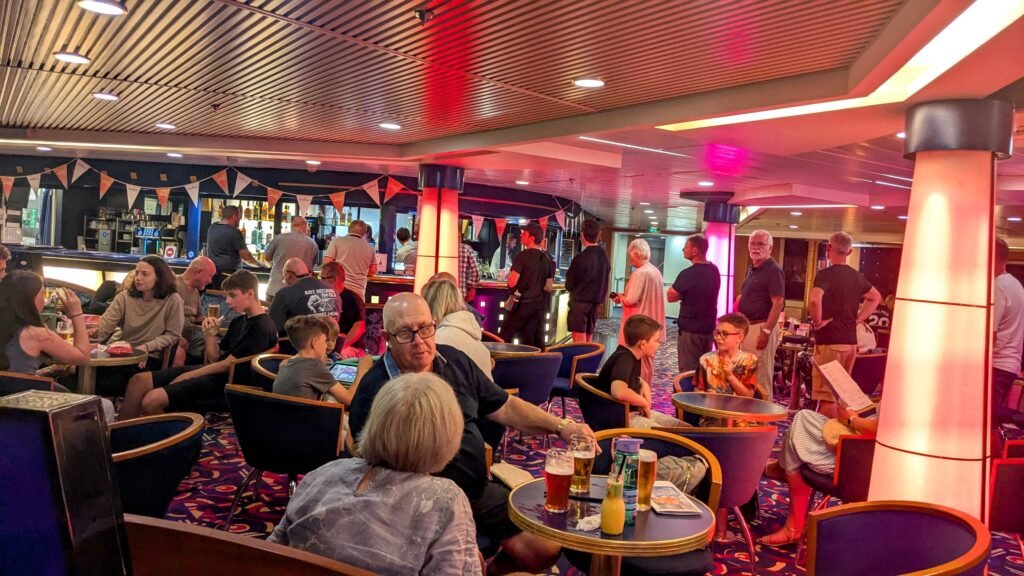
Find out what onboard facilities and amenities are on offer during your journey, including restaurants, cabins, duty free shops and maybe even a swimming pool, a kids club or a cinema, on one or two of the longer routes! This is what I like to do straight after boarding and it was always one of the most exciting parts of the whole ferry experience for me, as well as getting out on deck and watching as you slowly chug away from the port.
PET TRAVEL ON FERRIES
If you’re planning on travelling with your furry friend, then steel yourselves as this is a pretty complicated topic which requires a lot of preparation on your part. If you’re travelling with a dog, cat or a ferret (who has a ferret?!) the process seems to be a little more straightforward than with other species. Among other things, the pet travel documentation and other measures required include:
- Animal Health Certificate/EU Pet Passport
- Rabies vaccination
- Microchip
- Tapeworm treatment for dogs coming back into the UK
However, due to the complexity involved with bringing animals across borders, definitely review each carrier’s specific pet travel requirements and policies, as well as those for the country you plan to visit. Furthermore, if your pet is a Tortoise (hurray!) or something equally exotic, you may also require a CITES certificate for entry into the EU.

Here are the detailed pages on ferry pet travel for Brittany Ferries, P&O (who have their own dedicated ‘Pet Lounge’ on their Dover to Calais route!), DFDS, Irish Ferries and StenaLine. You’ll find details of their policies on where your animal can and can’t be on the ferry, potential kennel space on-board, as well as guidelines for boarding and other tips to make the journey for your pet as comfortable as possible.
ACCESSIBILITY ON BRITISH FERRIES
I’m not really qualified to talk about this, so I can only really give you an indication of how much information is available from each company’s websites:
P&O seem to offer comprehensive information on accessibility, which covers each of their ships and ports. They also link to Euan’s guide – an independent review site which provides real-life reviews of on-board experiences from people with mobility issues. Additionally, two of their newest ferries on the Dover/Calais route (P&O Pioneer and the P&O Liberte) have accredited Changing Places facilities – which are larger toilets designed to support children and adults with profound and multiple disabilities. Full details of P&O’s accessibility can be found here.
Brittany Ferries also has its own dedicated page with general travel advice for disabled passengers, from which they link to various other pages with information on port and ship facilities. I found the information a little harder to find and quite widely scattered across their site, and would advise them to collate more of this on fewer (ideally one) page.
Irish Ferries have a very comprehensive special assistance page, where give detailed information on disabled facilities for wheelchair users on all of their ships, information on disability discounts, and how to get Sunflower Lanyards for any passengers with hidden disabilities. They encourage you to reach out to them via email to their disability officer at least 2 days before travel to let them know of your needs. Most of the information I found was also just on one page, which was great!
Similarly, DFDS Seaways want to know of any special requirements at least two days before, but ideally at the time of booking. If you require an accompanying person to travel with you, DFDS may also offer free fares for this individual. Among the various information given is disabled toilet locations, port facilities, and lift dimensions. DFDS are also part of the Hidden Disabilities Sunflower programme, whereby travellers with non-visible disabilities or illnesses are easily recognised and given any support they may need on-board. Either pick up your lanyard on-board or email them before your trip.
TRAVELLING AS A FOOT PASSENGER
Here are the most important things to know about travelling as a foot passenger between the UK and Europe:
Generally speaking, travelling as a foot passenger is quite a bit more restrictive than taking your car, at least if you’re planning to depart the UK from Dover. P&O, for example, only allow foot passengers to travel on three of their daily crossings from Dover to Calais, whereas DFDS don’t allow foot passengers to travel at all on either their Dover to Dunkirk nor Dover to Calais routes.
Foot passenger space on all remaining ferry routes from the UK is also quite limited and is subject to availability on your particular ship.
Check in, boarding and disembarkation times are also a little different than when travelling with a vehicle, so do be sure to check the individual policies for the ferry company that you’re sailing with or risk missing your ferry! Of all the companies I checked, Brittany Ferries have the most comprehensive information about travelling as a foot passenger, and seem to be the most open to it!
Having said that, StenaLine have a couple of great deals going called the Dutchflyer Rail & Sail Rail, and Rail & Sail to Ireland. These includes massively discounted rail and ferry combined fares from several different British cities to their ferry ports in Ireland and the Netherlands. This is a brilliant offer for anyone committed to reducing their carbon footprints as far as possible.
Travel as a Foot Passenger and Rent a Car on Arrival
Absolutely, you can! For many reasons, it might be worth considering buying your ferry tickets as foot passengers, and then renting a car in Europe on arrival…
- If you’re price sensitive then this could save you money, although obviously you need to make sure that the cost of the car rental itself doesn’t outweigh the savings made on your ferry ticket.
- Renting a car in-situ may also make more sense for you if your existing UK car insurance or breakdown cover doesn’t cover international trips.
- Renting a car in France, Holland or Spain would also make sense if you’re worried about driving on the right in a vehicle with its steering wheel also on the right. This makes overtaking pretty dangerous guesswork, unless of course you’ve always got a willing passenger to help you check for oncoming vehicles.
If you are a little freaked out about driving on the right in a right hand drive car, then check out Discover Cars, as they aggregate the best prices of local vehicles from French, Dutch and Spanish car hire companies, thus avoiding this issue.
FERRY TRAVEL REQUIREMENTS: OUTRO
There are always a ton of things to do before going on holiday and I admit, all of this does sound like a lot, but follow these general requirements for travelling by ferry from the UK, and you’ll be good to go.
It’s totally worth the effort as taking a ferry from the UK is WAY more exciting than jumping on yet another anonymous plane. On a ferry you get to start your adventure earlier and give your family something new and exciting to experience.
If you’re headed to France and you’re looking for inspiration, then definitely check out my post on ferries to France, and for anyone considering taking a ferry to Spain, you may want to look at my Santander travel guide. Otherwise, check out my posts on England to Holland ferries or your options for ferries to Ireland.
Anyway, I hope this guide to UK ferry travel requirements has helped you with your planning, and I wish you many happy hours in Europe on your hols!



Travelling afternoon from Portsmouth, arriving Caen late evening. My husband has food allergies and we will be packing a picnic supper. Do we clear customs before boarding the ferry, or on arrival in France?
Similar question for the return trip a week later (July) when we leave France 8.30 a.m.
Hi Jacky,
Thanks for your question! You’ll be going through customs on arrival in Caen, and it’s the other way around on your return to trip to Portsmouth, but be sure to have all your documents (including for passport control) within easy reach at both ports in each direction.
Not sure if baguettes, brie and wine are on your husbands banned list of foods, I certainly hope not for his sake!
Have a great trip – James